
Brand Analysis
reMarkable The Paper Tablet: Is It Still the King of Focus in 2026?
Few gadgets have defined a category quite like the reMarkable. When the company launched its first device, they didn’t call it an “E-Ink Android Device” or a “Digital Note Taker.” They boldly branded it as remarkable the paper tablet. This wasn’t just marketing; it was a manifesto. They declared that paper—with its friction, simplicity, and lack of notifications—was superior to the glowing glass of the iPad.
Fast forward to 2026, and the landscape has shifted. We now have the high-end reMarkable Paper Pro with color screens and front lights. We have fierce competitors like Amazon and Boox offering devices that do more for less money. Yet, the core philosophy of **remarkable the paper tablet** remains unchanged: Better thinking through better writing. In this deep dive, we explore how this singular vision has evolved and whether it still deserves a place on your desk today.

The Philosophy of “Paper”
Why did the phrase remarkable the paper tablet resonate so deeply with millions of people? Because it promised an escape. In an era of “Everything Apps,” where your phone is your bank, TV, and mailbox, our brains are constantly overstimulated. The reMarkable promised to do less.
This is a concept known as “Single-Tasking.” By removing the browser, email client, and notification center, the device forces you into a state of flow. As noted by Cal Newport, author of Deep Work, tools that restrict our options often make us more productive. When you buy a **remarkable the paper tablet**, you aren’t paying for features; you are paying for the absence of them.
Hardware Evolution: rM1 to Paper Pro
The journey of **remarkable the paper tablet** has been one of slow, deliberate refinement rather than rapid iteration.
The reMarkable 2 (The Icon)
Launched in 2020, this device set the standard. At 4.7mm thin, it is still one of the thinnest tablets ever made. It featured a high-friction monochrome display that felt physically scratchy, like a pencil on paper. It had no front light, meaning you needed a lamp to use it. This limitation was touted as a feature—it was “just like paper.”
The reMarkable Paper Pro (The Modern Era)
In late 2024, the brand finally evolved. The new **remarkable the paper tablet** model (The Paper Pro) introduced “Canvas Color.” It added a front light and grew to 11.8 inches. However, the company was careful not to ruin the magic. The light doesn’t glow at you; it illuminates the surface. The colors are matte and textured, not glossy. They managed to modernize the specs without betraying the “paper” ethos.
The Connect Ecosystem
Hardware is useless without software. The ecosystem surrounding **remarkable the paper tablet** is built on seamless cloud syncing, but it hasn’t been without controversy.
The “Connect” Subscription:
To get the most out of the device, reMarkable encourages users to subscribe to “Connect.” This service offers unlimited cloud storage, handwriting conversion, and protection plans. While some users balk at paying a monthly fee for a notebook, it ensures the company’s revenue doesn’t depend on selling your data (unlike free apps). It keeps the platform private and secure.
The App Experience:
The companion apps for iOS, Android, and Windows are excellent. You can draft a note on your **remarkable the paper tablet** during a meeting, and it instantly appears on your laptop as a PDF, ready to be emailed. This bridge between the analog feel and digital workflow is what keeps professionals loyal.
Is It Still Unique?
In 2017, **remarkable the paper tablet** was one of a kind. In 2026, it is surrounded by rivals.
- Amazon Kindle Scribe: Offers a similar screen but locks you into the Amazon bookstore. It is a consumption device, not a creation device.
- Onyx Boox: Offers Android tablets with e-ink screens. They can do everything (email, video, web), but in doing so, they break the “focus” promise. They are just slower iPads.
- Supernote: The closest philosophical rival. Supernote focuses on durability and writing feel but lacks the polished UI and global cloud infrastructure of reMarkable.
Despite the competition, **remarkable the paper tablet** remains the only device that successfully balances premium hardware with a strictly minimalist software philosophy. It refuses to be a “computer.”
Final Verdict: Is It For You?
Should you buy a **remarkable the paper tablet** in 2026?
Yes, if:
- You are easily distracted by notifications on your iPad.
- You think best when holding a pen.
- You need to review long documents without eye strain.
No, if:
- You need to reply to emails directly from the device.
- You want to watch videos or browse the web.
- You are on a tight budget (competitors are often cheaper).
Ultimately, **remarkable the paper tablet** is a luxury tool for the mind. It is expensive, limited, and absolutely wonderful at the one thing it does: replacing paper.
Make Your Tablet Smarter
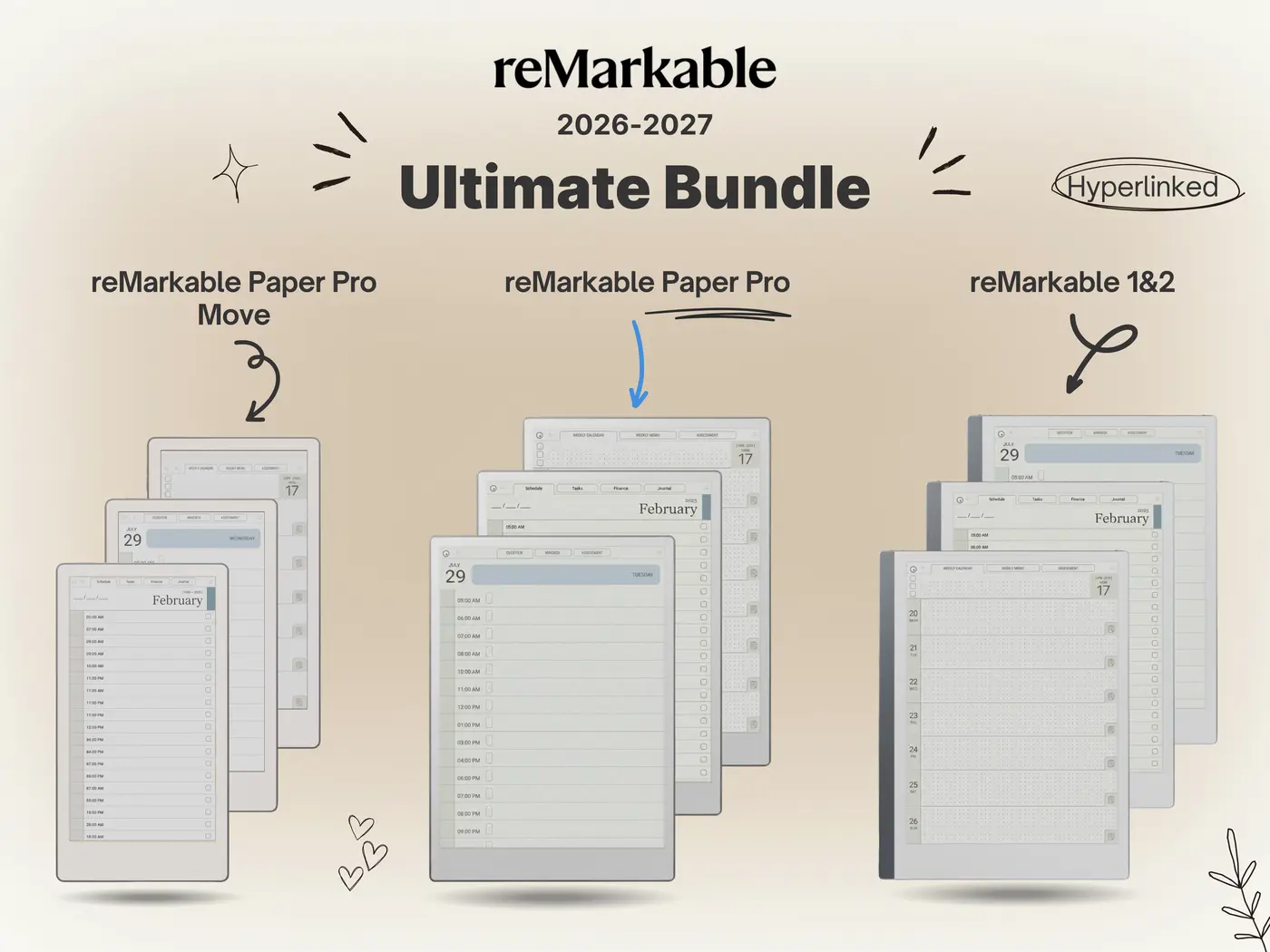
The device replaces the paper, but our templates replace the planner. Upgrade your workflow today.