Kindle Scribe OneNote Integration: Ultimate Sync Guide
Kindle Scribe OneNote Integration: Ultimate Sync Guide Productivity & Tech Mastering Your Kindle Scribe OneNote Integration Workflow For professionals who live in the Microsoft ecosystem,

Safest Method
RCU Software
For Developers
Manual SSH / SFTP
Best Alternative
Interactive PDFs
Customizing your digital workspace is the ultimate goal for any e-ink enthusiast, but navigating the world of a reMarkable Template Installer can be a minefield. Out of the box, the device offers a decent selection of grids and lines, but professionals often require specialized layouts like isometric dot grids, daily time-blockers, or complex project Kanban boards. To achieve this “native” integration, you must bypass the standard PDF import process and directly modify the tablet’s root Linux file system.
In this comprehensive 1,500-word analysis, we will deconstruct exactly how a reMarkable Template Installer functions beneath the surface. We will explore the technical differences between native background layers and interactive PDFs, analyze the safest tools available in 2026, and reveal the specific JSON configuration codes required to prevent your tablet from bricking during a firmware update. Let’s dive into the technical reality of modifying your digital paper.
Technical Deep Dive: It is critical to understand the architectural difference between a native template and a standard document. A native template is an SVG or PNG file stored deep within the device’s `/usr/share/remarkable/templates` directory. When you use a reMarkable Template Installer, you are injecting an image that the Xochitl UI (the proprietary operating system) recognizes as a selectable background. This allows you to add infinite pages to a notebook using that exact background design.
Workflow Application: Conversely, a PDF planner is a multi-page document imported via the cloud. You write on top of it, but you cannot easily “add a new page” of that PDF design without duplicating the entire file. If your goal is to have a single, repeating layout—like a daily journaling page—that you can infinitely expand inside a standard notebook, you must use the native injection method.
Technical Deep Dive: The manufacturer does not provide an official way to add native backgrounds. Because the file system is locked behind root access, you cannot simply drag and drop an image via a USB cable. A reliable reMarkable Template Installer establishes a Secure Shell (SSH) connection, mounts the read-only file system into read-write mode, and securely modifies the master JSON registry file without corrupting the syntax.
Workflow Application: For non-developers, attempting to edit the JSON file manually via a terminal window is highly risky. A single misplaced comma in the `templates.json` file will cause the notebook UI to crash entirely, rendering your device unusable until the syntax is corrected. Utilizing a verified GUI tool eliminates this risk by automating the code injection perfectly every time.
Technical Deep Dive: GitHub is filled with open-source scripts promising to install your templates. However, many of these were written for older firmware versions (pre-v3.0). When modern hardware like the Paper Pro transitioned from PNG to SVG formats for higher resolution scaling, these outdated scripts began corrupting devices. An outdated reMarkable Template Installer will push incorrect file types, causing severe memory leaks and battery drain during page refreshes.
Workflow Application: Before running any command-line script on your $500 tablet, verify its last update date. If a script has not been updated since 2024, do not use it on a 2026 device. Stick to widely vetted, actively maintained community tools to ensure your professional data remains secure and your hardware warranties are not accidentally voided by malicious or poorly coded software.

Technical Deep Dive: The reMarkable Connection Utility (RCU) is widely considered the most stable, professionally maintained third-party software for device management. It acts as a graphical reMarkable Template Installer that completely bypasses the manufacturer’s cloud. It communicates directly via USB, meaning your sensitive corporate data never touches a remote server. RCU handles the SVG conversion, JSON editing, and UI restarting automatically.
Workflow Application: If you value your time and device stability, spending the $12 for RCU is the smartest investment you can make. It transforms a highly technical, stressful process into a simple “drag-and-drop” interface. Furthermore, RCU includes an auto-restore feature, which is critical for surviving the inevitable operating system updates that periodically wipe the root directory.
Technical Deep Dive: For developers, the terminal is the ultimate reMarkable Template Installer. By enabling Developer Mode (Settings > General > Software > Advanced), you gain root access. You use the command `ssh root@[Device-IP]` to log in. The critical technical step is executing `mount -o remount,rw /`, which tells the Linux kernel to unmount the locked file system and remount it with Read-Write permissions, allowing you to inject your SVGs via Secure Copy Protocol (SCP).
Workflow Application: Use this method only if you are comfortable with command-line interfaces. It provides absolute control over your file hierarchy and allows you to build custom bash scripts that can automatically fetch templates from your local NAS server. This is the preferred workflow for IT professionals who treat their e-ink tablet as a programmable Linux machine rather than a simple consumer device.
Technical Deep Dive: If you want the control of SSH without the anxiety of a black terminal window, an SFTP client is your best hybrid reMarkable Template Installer. Software like Cyberduck provides a visual file browser for your tablet’s root directory. You can navigate to `/usr/share/remarkable/templates`, drag your SVG files into the folder, and right-click to edit the `templates.json` file using your preferred desktop text editor like VS Code.
Workflow Application: This is the ideal middle-ground. It allows you to visually confirm that your files have successfully transferred to the correct directory. When using Cyberduck, always make a duplicate copy of the `templates.json` file on your desktop before making any edits. If you accidentally corrupt the code, you can instantly drag the original file back over to restore the tablet’s functionality in seconds.
Executing a manual installation requires strict adherence to the Linux directory structure. Follow this step-by-step map to ensure a flawless native integration.
mount -o remount,rw / command to enable write permissions across the root system.
templates.json registry file and reboot the device UI to compile the changes.
Technical Deep Dive: Before initiating any reMarkable Template Installer process, you must secure your existing data. Modifying the root directory carries the inherent risk of a boot loop. Ensure your device is fully synced to the official cloud. If you are operating entirely offline, use a tool to pull your `.rmn` (reMarkable Notebook) archive files to your local hard drive. This guarantees that your handwritten notes survive even if the operating system requires a factory reset.
Workflow Application: Treat root access like performing surgery on your workflow. Set aside 30 minutes of uninterrupted time. Design your templates beforehand, ensuring they are exported at the correct pixel dimensions (1620 x 2160 for the Paper Pro) to prevent the device from utilizing CPU power to aggressively scale your images, which ruins the crispness of the e-ink display.
Technical Deep Dive: The core of a manual reMarkable Template Installer is the JSON array. You must insert an object block that defines your file. The syntax requires specific parameters: `”name”`, `”filename”`, `”iconCode”`, `”landscape”`, and `”categories”`. The `iconCode` (e.g., `”\ue9a8″`) determines the visual thumbnail displayed in the tablet’s interface. If you miss a quotation mark or a trailing comma separating the objects, the parser will fail.
Workflow Application: Use a JSON validator online before saving your edits. When defining the `”categories”` array, use existing tags like `”Life/organize”` or `”Grid”`. This ensures your custom layout is logically sorted within the native UI, allowing you to quickly find your specialized Meeting Notes template during a high-pressure client call rather than scrolling through a disorganized master list.
Technical Deep Dive: After your reMarkable Template Installer completes the transfer, you will not see the templates immediately. The Xochitl UI loads the JSON registry into RAM upon boot. You must either physically restart the tablet or execute the `systemctl restart xochitl` command via SSH. This forces the device to dump the old memory cache, parse your newly edited JSON file, and populate the UI with your custom SVG backgrounds.
Workflow Application: If the device reboots and the screen gets stuck on “Starting,” your JSON file has a syntax error. Do not panic. Simply SSH back into the device, open the backup copy of your `templates.json` that you wisely created earlier, and overwrite the corrupted file. Restart the Xochitl process again, and your device will boot normally, saving your workflow from disaster.
Technical Deep Dive: The fatal flaw of using any native reMarkable Template Installer is the firmware update cycle. When the device downloads a new OS version, it completely overwrites the root partition, including the `/usr/share/remarkable/templates` directory. Your custom SVGs and your modified JSON file will be instantly deleted, reverting the UI back to factory settings. However, notebooks that previously used those backgrounds will retain the visual lines until you attempt to change the layer.
Workflow Application: You must accept that native templates are temporary residents on your device. Never rely on a custom native background if you are unwilling to reinstall it every few months. For highly complex, mission-critical documents, read our guide on How to Make Templates for reMarkable 2: The Ultimate DIY Guide, which explains why PDF planners are technically immune to firmware wipes.
Technical Deep Dive: To mitigate update fatigue, experienced developers maintain a local “Injection Folder” on their PC. This folder contains all custom SVGs and a pre-written text snippet of their JSON array additions. When an update wipes the tablet, their custom reMarkable Template Installer script simply pushes the contents of this folder back to the device via SCP in under 5 seconds, automating the restoration process.
Workflow Application: Create a desktop folder named “Tablet Restoration.” Keep your finalized SVGs and a Notepad file with your exact JSON code blocks here. When an update hits, you won’t have to scramble to remember which `iconCode` you used or how you spelled the filename. This proactive organization turns a frustrating system wipe into a minor, 60-second inconvenience.
Technical Deep Dive: Occasionally, a major firmware update will change the overarching structure of the `templates.json` schema. If a manufacturer adds a new required parameter (e.g., a specific tag for Gallery 3 color rendering), your old reMarkable Template Installer scripts may inject outdated code, causing visual glitches or UI crashes. You must monitor developer forums to ensure your JSON formatting matches the latest software version requirements.
Workflow Application: Delay installing new firmware updates for at least two weeks. Let the developer community test the new OS structure. Once tools like RCU are updated to support the new firmware architecture, it is safe to upgrade your tablet. This disciplined approach ensures your professional productivity is never derailed by experimental software changes.
| Template Type | Installation Method | Firmware Survival | Hyperlink Support |
|---|---|---|---|
| Native SVG Layer | SSH / RCU Utility | Low (Wiped often) | No |
| Interactive PDF | Official Desktop App | High (Permanent) | Yes |
| Static PDF | Official Cloud Sync | High (Permanent) | No |
Technical Deep Dive: If you are using a reMarkable Template Installer for the Paper Pro, you must account for the Canvas Color display. The Gallery 3 technology handles high-contrast black beautifully but struggles with heavy, dark backgrounds, which slow down the refresh rate. Your custom SVGs should utilize thin, light-gray lines (#E5E7EB) and maximize white space to ensure the tablet remains snappy and responsive during heavy writing sessions.
Workflow Application: Design your templates to be “Quiet.” Do not use heavy borders or thick black grids. A minimalist design allows your colored marker inputs—red for urgency, blue for ideas—to stand out visually. This design philosophy transforms your custom template into a high-performance cognitive tool, leveraging the hardware’s strengths while avoiding its technical limitations.
Technical Deep Dive: The new 7.3-inch form factor requires unique geometry. If you push a 10.3-inch SVG to the Move using a reMarkable Template Installer, the UI will compress the image, resulting in microscopic, unusable writing lines. You must export specific assets natively at 1696 x 954 pixels. Furthermore, the aspect ratio dictates a “Vertical-First” design methodology to accommodate the narrower screen width.
Workflow Application: For maximum efficiency on smaller devices, design your layouts to mimic a steno pad. Use a single vertical line down the center of the page. This forces you into a “Rapid Logging” mindset, which is perfectly suited for mobile, one-handed operation during commutes or site visits, as detailed in our guide: reMarkable Template Creator | Design Your Own Custom Templates.
Technical Deep Dive: The ultimate truth of the reMarkable Template Installer is that it is often unnecessary for top-tier productivity. Advanced professional workflows rely on hyperlinked navigation—jumping instantly from a Monthly Calendar to a Daily Action Log. Native SVG backgrounds cannot support interactive links. To achieve this, you must abandon the root-access method and utilize highly optimized PDF planners uploaded via the official cloud.
Workflow Application: Evaluate your needs. If you just want a custom isometric grid for sketching, use SSH and install the native layer. But if you need a comprehensive, year-long organizational system that acts as a digital dashboard, switch to a PDF framework. The time saved navigating a hyperlinked document far outweighs the ability to add infinite pages to a static notebook, making it the superior choice for serious professionals.
Using a reMarkable Template Installer allows you to inject custom, infinite-page background layers directly into your tablet’s UI. While GUI tools like RCU offer the safest route, advanced users can utilize SSH to modify the `templates.json` file manually. However, because these native files are wiped during every firmware update and lack hyperlink support, most high-level professionals are better served by abandoning root modifications entirely in favor of hyperlinked, interactive PDF planners.
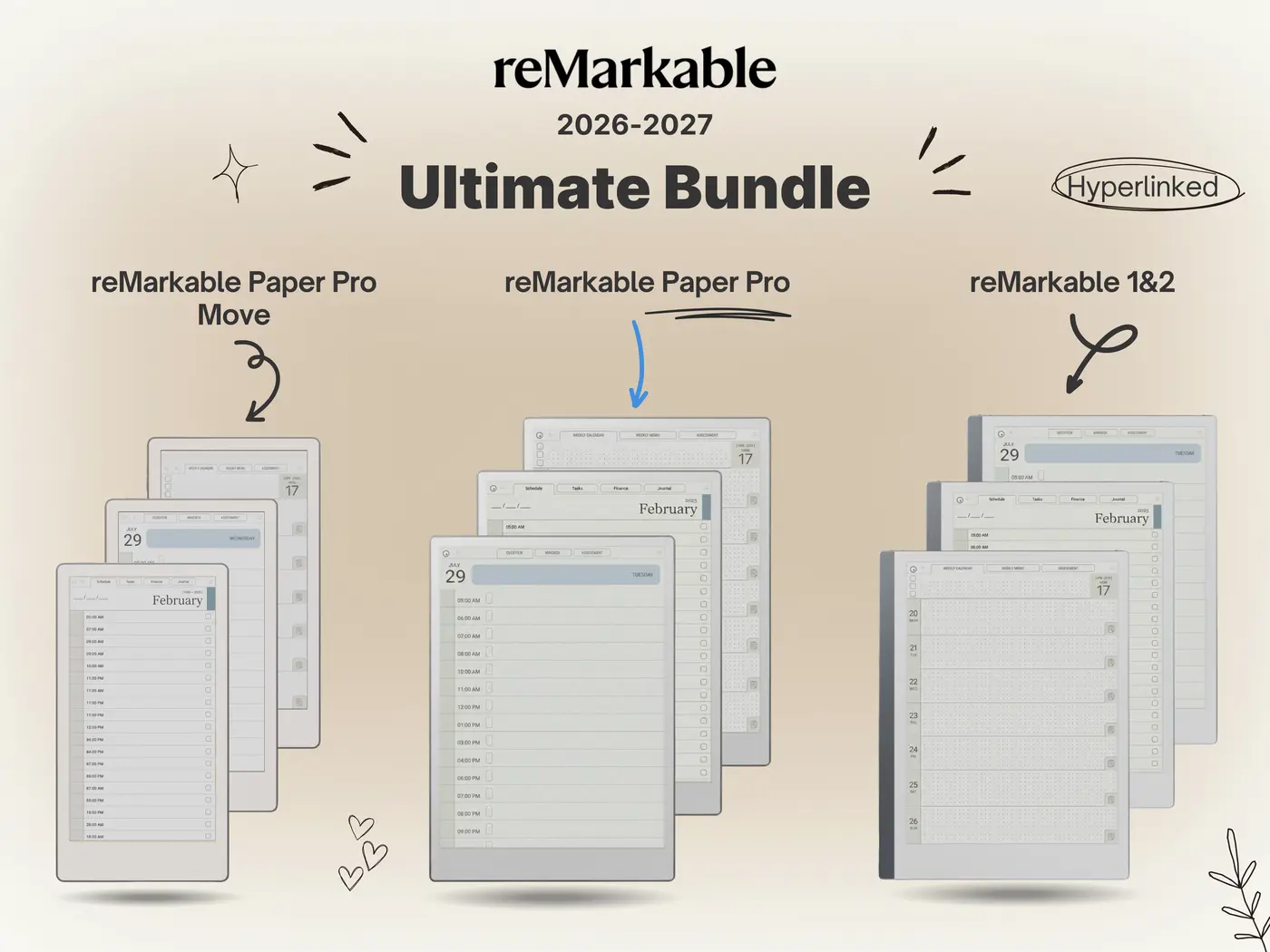
Tired of risking your tablet’s operating system with manual code injections? Upgrade your workflow instantly with our Ultimate Template Bundle. Hyperlinked, perfectly scaled, and 100% immune to firmware updates.
Shop the Professional Bundle
3 Responses