
Hardware Comparisons
reMarkable Paper Pro vs Boox: The 2026 Color E-Ink Showdown
For years, the e-ink market was defined by compromise. You could either have the sublime writing feel of the black-and-white reMarkable 2, or you could have the versatile but clunky color experience of Onyx Boox devices. In 2026, that compromise is officially dead. With the release of the **reMarkable Paper Pro**, the Norwegian company has finally entered the color arena, aiming directly at the dominance of the **Boox Note Air 4 C** (and its predecessor, the Air 3 C).
If you have $600 burning a hole in your pocket, choosing between these two titans is agonizing. On paper, they look similar: both have color screens, both handle PDFs, and both replace your physical notebooks. But in practice, they are philosophically opposite machines. The **remarkable paper pro vs boox** debate isn’t just about specs; it is about “Focus” versus “Features.” Do you want a distraction-free sanctuary, or do you want an iPad with an e-ink screen? In this guide, we dissect the screen technology, the writing experience, and the software ecosystems to help you make the right choice.

The Battle of the Screens: Canvas Color vs Kaleido 3
The most critical difference in the **remarkable paper pro vs boox** comparison is the display technology. They are fundamentally different beasts.
Boox: Kaleido 3
Boox uses industry-standard Kaleido 3 technology. This places a Color Filter Array (CFA) on top of a standard black-and-white screen.
• Pros: High refresh rate (you can almost watch video).
• Cons: The color filter makes the screen darker, meaning you almost always need the backlight on. The screen has a visible “screen door” texture if you look closely.
reMarkable: Canvas Color
reMarkable uses a custom version of E Ink Gallery 3, branded as “Canvas Color.” The color particles themselves move inside the capsule.
• Pros: The colors look “painted on” and textured. There is no filter array between your pen and the ink, so the writing looks closer to the surface.
• Cons: It is slower. When you switch pen colors, the screen has to “flash” to reset the particles.
Writing Feel: Texture vs Glass
If your primary goal is writing, this section determines the winner of the **remarkable paper pro vs boox** duel.
The reMarkable Experience:
The Paper Pro maintains the legendary “scratchy” feel of its predecessor. The screen is textured glass that physically bites into the Marker tip. It sounds like a pencil on cardstock. The latency is roughly 12ms, but because of the Canvas Color tech, the ink feels like it flows directly out of the pen tip.
The Boox Experience:
Boox tablets, like the Note Air series, use a smoother glass surface with a factory-applied matte film. It feels more like a high-quality gel pen on glossy paper—smoother, faster, but with less control. While Boox has improved latency significantly, the gap between the glass and the e-ink layer is visually thicker than on the Paper Pro.
OS Wars: Linux vs Android
This is where the user base splits. The **remarkable paper pro vs boox** comparison is effectively a choice between a “Walled Garden” and the “Wild West.”
- reMarkable (Linux): You cannot install apps. You cannot check email. You cannot browse the web. The device does one thing: digital paper. This limitation is a feature, not a bug. It forces you to focus.
- Boox (Android): The Note Air 4 C runs full Android 13/14 with the Google Play Store. You can install Obsidian, Notion, Kindle, Outlook, and even YouTube. It is a full-blown tablet that happens to have an e-ink screen.
If you need to sync your handwritten notes directly into OneNote or Evernote, Boox wins. If you want to escape notifications and think deeply, reMarkable wins.
The Battery Life Reality Check
Color screens consume more power than monochrome ones, but the operating systems play a huge role here.
Boox: Because it runs Android and uses “Boox Super Refresh” (BSR) technology to smooth out ghosting, the battery drains fast. Heavy users report needing to charge the Note Air C series every 2 to 3 days.
reMarkable: The minimalist Linux OS is incredibly efficient. Even with the new backlit screen, the Paper Pro easily lasts for two weeks of daily use. If you hate carrying chargers, the reMarkable is the clear victor in the **remarkable paper pro vs boox** stamina test.
Front Light Implementation
Both devices now have lights, allowing you to work in the dark. However, the implementation differs.
The Boox light shines through the screen layers. It is bright, stark, and can get extremely cold (blue) or warm (orange). It feels like a computer monitor.
The reMarkable Paper Pro uses a unique reflective light that shines onto the e-ink surface from the sides. It creates a much softer, more natural glow that looks like a bedside lamp illuminating a physical book. It is significantly easier on the eyes during late-night study sessions.
Final Verdict
So, who wins the **remarkable paper pro vs boox** battle of 2026?
Buy the Boox Note Air 4 C if:
You need a productivity powerhouse. You want to read Kindle books, reply to emails via Outlook, and sync tasks to Notion—all on one device. You are willing to sacrifice writing feel and battery life for sheer capability.
Buy the reMarkable Paper Pro if:
You want a thinking tool. You value the tactile sensation of writing above all else. You want a device that helps you disconnect from the noise of the internet. The superior writing feel, battery life, and distraction-free ethos make it the ultimate digital notebook.
Power Your Choice
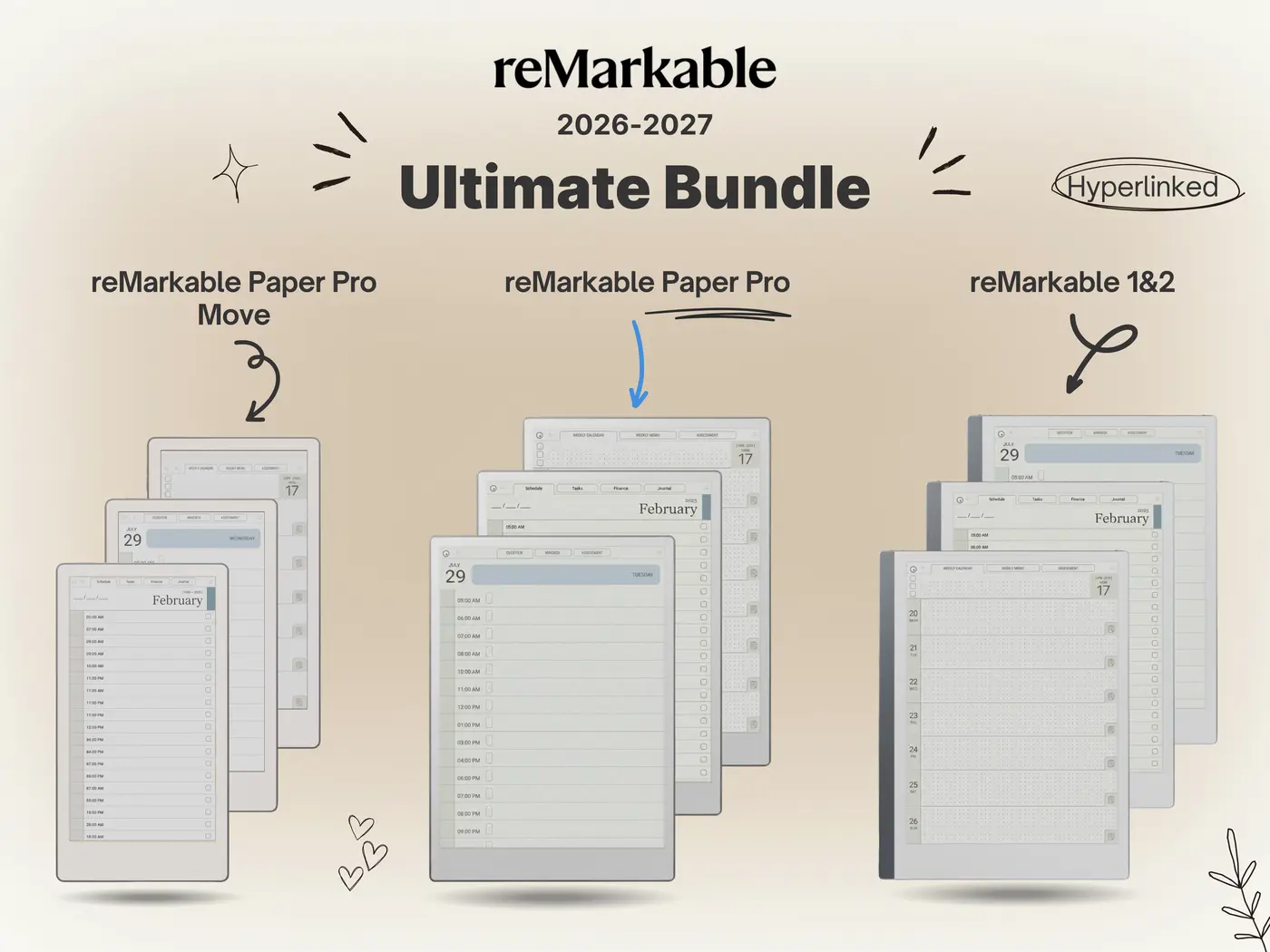
Whichever device you choose, you need a system to stay organized. Our 2026 Planner Bundles are available in both PDF formats (reMarkable) and Android-friendly versions (Boox).