Kindle Scribe OneNote Integration: Ultimate Sync Guide
Kindle Scribe OneNote Integration: Ultimate Sync Guide Productivity & Tech Mastering Your Kindle Scribe OneNote Integration Workflow For professionals who live in the Microsoft ecosystem,

In an era flooded with high-refresh-rate OLED screens and constant notifications, a single-purpose digital notebook feels almost defiant. Despite the release of newer color models, the remarkable 2 remains a cornerstone of the productivity community. Here is our brutally honest review of why the classic monochrome tablet still commands attention.

Most consumer electronics are designed to capture your attention and sell it to advertisers. The iPad is a spectacular piece of machinery, but it is fundamentally a consumption device. It is built for doing a hundred things at once: answering emails, watching Netflix, and casually browsing social media. When you pick up the remarkable 2, you are opting out of that ecosystem entirely. The iPad is for doing; the E-Ink tablet is for thinking.
The physical footprint of the remarkable 2 is astonishingly thin at just 4.7mm. It weighs 403g, making it lighter than a standard paper notebook of the same size. The asymmetrical bezel provides a natural grip for your left hand (or right, if you flip the interface), preventing accidental page turns. This hardware is not trying to be a laptop replacement. It is a dedicated capture tool designed for deep, uninterrupted work.
In the age of endless digital noise, the value proposition of a device that literally cannot open a web browser is higher than ever. It forces you to sit with your thoughts, prioritize your tasks, and execute without the persistent anxiety of unread notifications.
When you evaluate the remarkable 2, you have to look closely at the display technology. The device uses an E Ink Carta display with a resolution of 1404 x 1872 pixels. This translates to 226 DPI (Dots Per Inch). While the newer Paper Pro bumps this slightly to 229 DPI with color capabilities, the classic monochrome screen holds a distinct advantage in one specific area: contrast.
Because it lacks the additional color filter layers found on modern Gallery 3 screens, the text on the remarkable 2 appears incredibly sharp against its light grey background. According to the engineers at E Ink Corporation, fewer layers above the pigment capsules result in a crisper image and a shorter distance between the pen tip and the “ink.”
Furthermore, the matte finish diffuses overhead light perfectly. You can take this tablet outside in direct sunlight—a scenario where traditional LCD screens become useless mirrors—and the screen actually becomes easier to read. It is the closest digital facsimile to a physical sheet of paper on the market.
If the hardware is the chassis, the writing experience is the engine. Writing on a glass screen feels like dragging a piece of hard plastic across an ice rink. The friction on the remarkable 2 is engineered specifically to mimic graphite on high-quality sketch paper.
When you use the Marker or the Marker Plus, the textured surface of the screen provides auditory and tactile feedback—a satisfying “scratch” that signals to your brain that physical work is happening. The latency is impressively low (around 21ms). While Apple has driven their latency down even further, the difference is negligible for handwriting. The digital ink flows precisely from the tip of the stylus without noticeable lag.

We highly recommend the Marker Plus over the standard Marker. Having a dedicated, physical eraser on the back of the stylus allows you to correct mistakes without breaking your flow state to tap a UI menu. It is a small quality-of-life improvement that pays massive dividends over a year of daily use.
The operating system on the remarkable 2 is minimalist by design. You have folders, notebooks, and quick sheets. Out of the box, the device provides basic lined, dotted, and grid pages. For a quick sketch, this is fine. For managing a complex professional life, it is woefully inadequate.
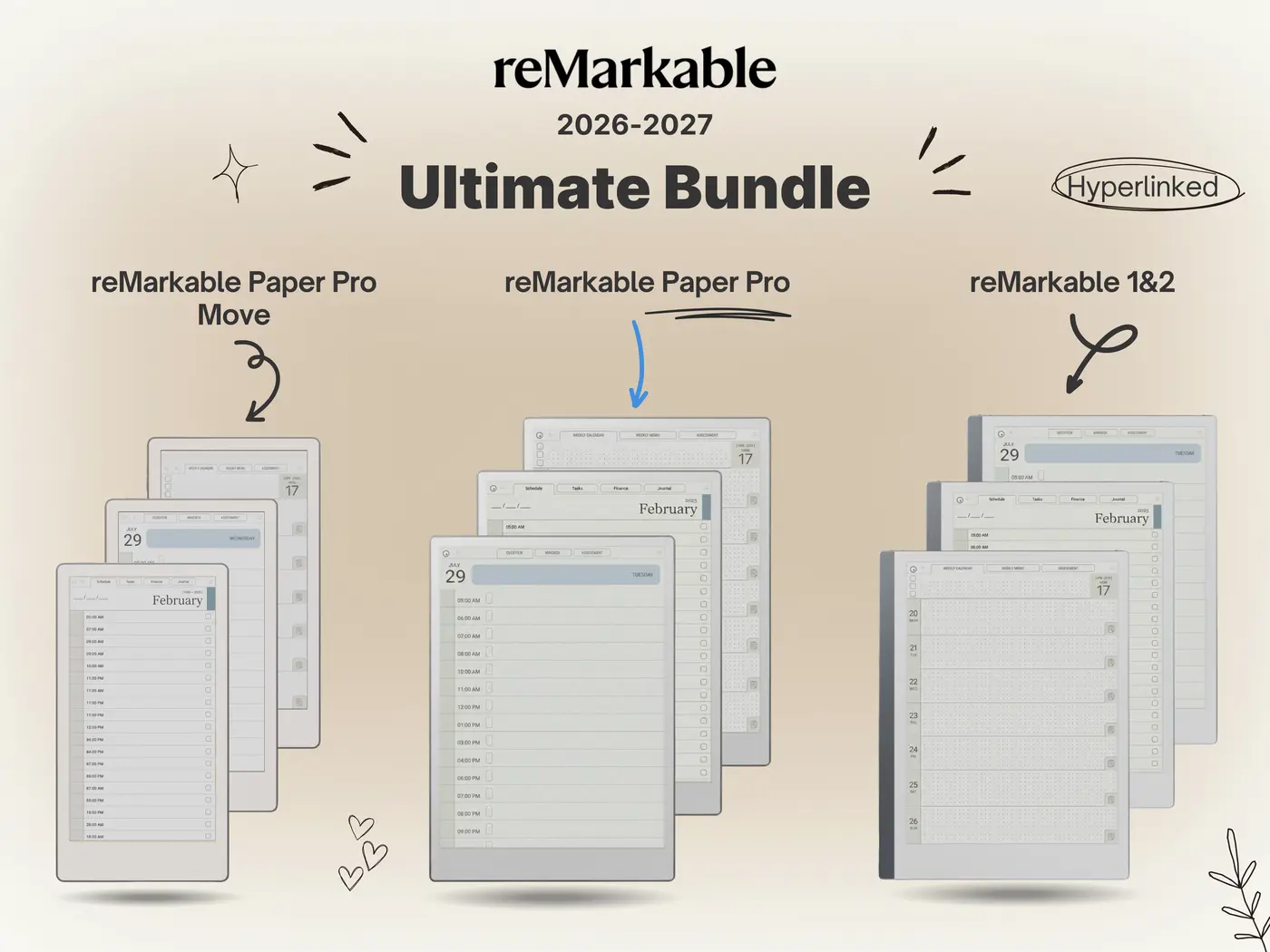
This is where the tablet transitions from a digital sketchpad into a productivity command center. You can—and absolutely should—import interactive PDF documents to serve as the structural backbone of your workflow. By loading a custom planner onto your remarkable 2, you gain hyperlinked tabs, daily time-blocking grids, and dedicated project indexes that the native software simply cannot provide.
As noted by reviewers at Wired, the hardware shines brightest when you stop relying on the default notebooks and start utilizing structured templates. When you tap a hyperlink in a PDF, the tablet instantly jumps to the corresponding page, creating an app-like navigation experience without the bloat of actual applications.
We believe in building trust through honesty. Let’s be brutally straightforward about the limitations of the remarkable 2, because it is not the perfect device for everyone.
However, the trade-off for that sluggish processor is battery life. The battery life of the remarkable 2 easily stretches into a second week of heavy daily use. Try getting more than 10 hours out of a modern LCD tablet.
| Feature | Specification | Real-World Impact |
|---|---|---|
| Display | 10.3″ monochrome digital paper | Zero eye strain, high contrast outdoors. |
| Battery | 3000 mAh | Up to two weeks of battery life. |
| Storage | 8 GB internal storage | Holds roughly 100,000 pages of notes. |
| Connectivity | Wi-Fi 2.4 GHz / 5 GHz | Syncs notes securely to the official reMarkable cloud. |
In 2026, the tech landscape is obsessed with putting AI into everything and making every screen a vibrant color display. The remarkable 2 completely ignores these trends, and it is better for it.
If you need to color-code your notes or read comic books, you should look at the Paper Pro or an iPad. But if you are a writer, a student, a project manager, or simply someone seeking a distraction-free environment, the remarkable 2 remains the gold standard for pure, unadulterated focus. It is a premium, beautifully crafted sanctuary for your thoughts.
The hardware is a blank slate. The software provides the ink. But to truly master the device, you need the right framework.
Hardware is only half the equation. Unlock the true potential of your remarkable 2 with our completely integrated, high-contrast digital planner.
Shop the 2026 Template Bundle →
4 Responses