
Software & Downloads
Best reMarkable Planner Templates 2026: Free vs. Premium Guide
The reMarkable tablet is a paradox. The hardware is an engineering marvel—distraction-free, perfectly textured, and impossibly thin. Yet, the software experience out of the box can feel surprisingly sparse. You get a few basic grids, some lined paper, and perhaps a simple checklist. For a device that costs upwards of $400 (or $600 for the Paper Pro), many users expect more.
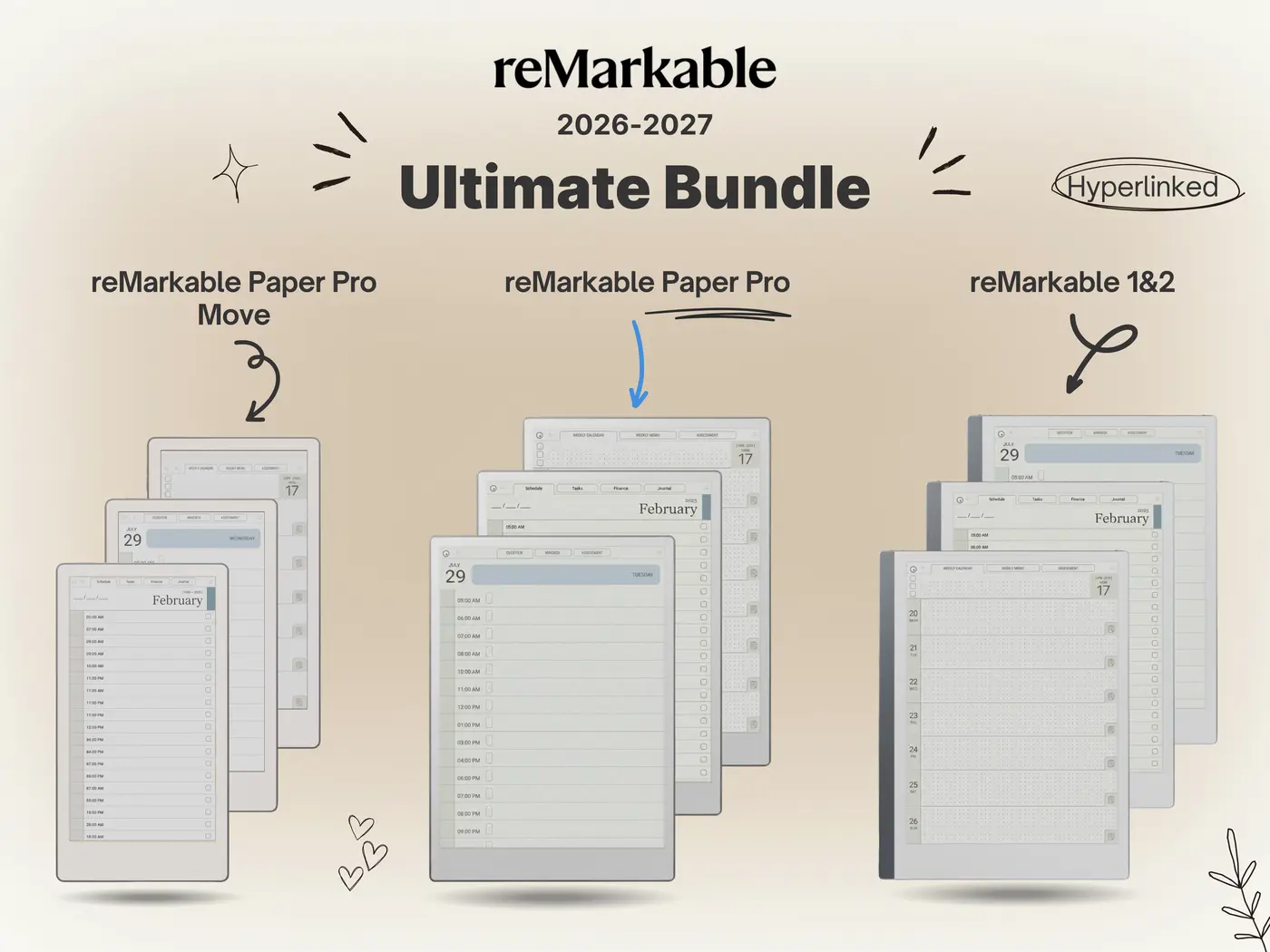
This is where third-party PDFs come in. The community of creators has stepped up to build what reMarkable didn’t: comprehensive, hyperlinked organizational systems. Whether you are a project manager needing to track deliverables or a student juggling semesters, finding the **best remarkable planner templates** is the key to unlocking the device’s true potential. In this guide, we explore the landscape of 2026 templates, helping you decide between free open-source options and premium professional bundles.

1. The Daily Organizer
The core of any productivity system is the Daily Page. The **best remarkable planner templates** for daily use usually offer one of two formats:
The Time-Blocker:
A vertical timeline running from 6:00 AM to 10:00 PM. This is ideal for people with heavy meeting schedules who need to visualize their “white space.”
The Task-Lister:
A layout that prioritizes a “Top 3 Tasks” box, followed by a general to-do list and a notes section. This is preferred by creatives and developers who measure output, not hours.
Pro Tip: Look for a template that includes a “Habit Tracker” at the bottom of the daily page so you don’t have to switch files to log your water intake.
2. The Meeting Master
Standard notebooks are terrible for meetings because notes get lost chronologically. A specialized Meeting Template is essential.
What to look for:
• Metadata Headers: Fields for “Date,” “Attendees,” and “Objective.”
• Action Item Grid: A dedicated box at the bottom right for “Who” is doing “What” by “When.”
• Index Link: A button that returns you to a master “Meeting Index” page so you can see a list of all your meetings at a glance.
Using a template like this makes you look incredibly professional in front of clients. It shows you are organized and deliberate.
3. The Project Dashboard
For long-term work, you need more than daily pages. You need a Project Dashboard. Among the **best remarkable planner templates**, this is the most complex file type.
It acts like a “website” inside your tablet. The main page lists your 10-20 active projects. Clicking on a project name takes you to a sub-section dedicated to that project, containing:
• Kanban Boards (To Do / Doing / Done)
• Gantt Charts (Timelines)
• Budget Trackers
This hierarchy prevents your “Project A” notes from getting mixed up with your “Project B” brainstorming.
Paper Pro: The Color Revolution
If you own the new reMarkable Paper Pro, do not use templates designed for the reMarkable 2. They will look flat and boring.
The Paper Pro’s Canvas Color display allows for functional color coding. The **best remarkable planner templates** for this device use:
• Soft Blue for hyperlinks (navigation).
• Alert Red for urgent priority boxes.
• Muted Green for weekend shading.
Be careful with “dark mode” templates on the Paper Pro. Because the screen relies on reflected light (E Ink), heavy black backgrounds can sometimes look ghostly or suffer from refresh issues. Stick to “Light Mode” with colorful accents for the best performance.
How to Install Templates
Many users are intimidated by the word “template.” Don’t be. You don’t need to hack your device. Here is the standard workflow:
- Download: Get the PDF file (usually a .zip) to your computer.
- Import: Drag the PDF into the official reMarkable desktop app.
- Sync: Let the cloud update your tablet.
- Navigate: Open the file on your device. Note: To use hyperlinks, ensure your pen tool is set to “Navigation Mode” (or use a finger tap). If you try to tap a link with the pen in “Writing Mode,” it will just draw a dot.
For advanced users who want to change the native background templates (the ones that appear in the settings menu), you will need third-party tools like RCU (reMarkable Connection Utility), but this is not necessary for standard PDF planners.
Final Verdict
Your hardware is only as good as the software you run on it. Investing $500 in a tablet and then refusing to spend $20 on the **best remarkable planner templates** is a false economy.
For the ultimate setup, we recommend a “Master Bundle” that includes a hyperlinked Daily Planner, a Meeting Log, and a Project Tracker. This ecosystem approach ensures that all your notes speak the same design language, keeping your digital workspace calm, organized, and productive.
Complete Your Digital Desk
Stop searching for free files that break. Download our 2026 Ultimate Bundle, fully hyperlinked and optimized for both reMarkable 2 and Paper Pro.