Kindle Scribe OneNote Integration: Ultimate Sync Guide
Kindle Scribe OneNote Integration: Ultimate Sync Guide Productivity & Tech Mastering Your Kindle Scribe OneNote Integration Workflow For professionals who live in the Microsoft ecosystem,

Best For Apps
Onyx Boox Series
Best For Writers
Supernote A5 X2
Best For Value
Kindle Scribe
| Device Model | Display Tech & Size | Operating System | Base Price (w/ Stylus) | Best Suited For |
|---|---|---|---|---|
| reMarkable Paper Pro | 11.8″ Gallery 3 (Color) | Linux (Closed) | ~$658.00 | Absolute distraction-free focus |
| Onyx Boox Note Air 4C | 10.3″ Kaleido 3 (Color) | Android 13 (Open) | ~$499.00 | Google Play app integration |
| Supernote A5 X2 | 10.7″ Carta 1200 (B&W) | Chauvet Linux | ~$518.00 | Internal hyperlinking & databases |
| Amazon Kindle Scribe | 10.2″ Carta 1300 (B&W) | Kindle OS (Closed) | ~$339.00 | Value and reading libraries |
The pioneer of the digital paper movement successfully convinced millions of users that a distraction-free, locked ecosystem was the ultimate path to productivity. However, as workflows mature in 2026, the demand for highly integrated, open-architecture devices has skyrocketed. When searching for viable remarkable alternatives, professionals are actively looking to escape recurring cloud subscription fees, limitations on third-party application support, and the rigid confines of closed Linux operating systems.
In this massive, 1,500-word technical analysis, we will thoroughly dissect the competitive landscape of digital notebooks. We will explore how Android-based e-ink tablets leverage specialized GPUs to handle Google Play apps, evaluate the unique ceramic stylus technology of the Supernote, and map out the financial realities of abandoning proprietary cloud storage. Whether you are an academic annotating massive PDFs or an executive searching for an interconnected dashboard, understanding these top remarkable alternatives guarantees your next hardware investment aligns perfectly with your cognitive workflow.
Technical Deep Dive: The most frequent reason users hunt for remarkable alternatives is the need for software versatility. The Onyx Boox lineup (specifically the Note Air 4C) operates on a fully certified Android 13 ecosystem. This provides native access to Google Mobile Services (GMS) and the Play Store. It features a Qualcomm octa-core processor paired with 6GB of RAM, allowing the device to run heavy applications like Microsoft Teams, Notion, and Outlook without aggressively throttling the CPU.
Workflow Application: This architecture transforms the e-ink tablet into a genuine laptop replacement. You can review a contract on the glare-free screen, digitally sign it, and instantly upload it directly to your corporate Slack channel without ever touching a computer. For professionals who are deeply entrenched in collaborative software, this open ecosystem provides the most seamless, uninterrupted operational pipeline on the market.
Technical Deep Dive: The fatal flaw of rendering standard Android applications on e-paper is screen latency and severe “ghosting” (faint shadows of previous images). To combat this, Boox engineered a proprietary hardware GPU called Boox Super Refresh (BSR). This dedicated chip aggressively clears the microcapsules at up to 15 frames per second, actively interpolating the signal between the Android software and the e-ink backplane to force smooth scrolling.
Workflow Application: While evaluating remarkable alternatives for high-speed multitasking, the Boox hardware neutralizes the sluggish input lag that typically makes e-ink unbearable for standard web browsing. Because of the BSR technology, you can comfortably browse visually heavy web portals or scroll through your inbox without the jarring black-flash screen resets that interrupt your train of thought.
Technical Deep Dive: The inherent danger of an open Android ecosystem is the reintroduction of the very distractions e-ink was designed to eliminate. However, open ecosystems allow for aggressive app-level management. You can universally disable push notifications, freeze background app refreshes to preserve battery life, and force individual apps to launch strictly in high-contrast, black-and-white “Regal” modes to prevent colorful notification badges from stealing your attention.
Workflow Application: To maintain your focus, treat the device like a highly customized workstation. Delete social media apps entirely. Use the split-screen functionality to lock a PDF planner on the left side of the screen while keeping a single, necessary reference app (like Google Keep) open on the right. This setup provides all the utility of an iPad with none of the neurological drain.

Technical Deep Dive: When assessing remarkable alternatives based purely on writing feel, the Supernote A5 X2 utilizes a fascinating engineering approach. Instead of a hard plastic nib on textured glass, Supernote employs a never-wear ceramic nib paired with a soft, self-healing “FeelWrite 2” polymer film over the screen. This Wacom EMR digitizer configuration perfectly simulates a ballpoint pen pressing and slightly “digging” into a stack of high-quality paper.
Workflow Application: For authors, journalists, and heavy note-takers, this is a massive financial and ergonomic win. You never have to purchase replacement stylus tips again. The tactile response provides a smoother, more deliberate writing speed that drastically improves cursive legibility over long, intensive brainstorming sessions.
Technical Deep Dive: The Supernote’s proprietary Chauvet operating system is arguably the most sophisticated offline database engine in the e-ink space. It features a native “Lasso” tool that allows you to circle any handwritten word and designate it as a searchable “Heading” or a “Keyword.” Furthermore, it supports deep internal hyperlinking, allowing you to tap a handwritten note and teleport to a related PDF.
Workflow Application: If you are managing massive, multi-faceted projects, this system makes the Supernote one of the most capable remarkable alternatives available. You can build an entire interconnected wiki of your own handwriting without relying on third-party software. It essentially functions as a physical bullet journal with the immediate search and retrieval capabilities of an enterprise server.
Technical Deep Dive: Supernote prioritizes absolute data sovereignty. While it supports basic cloud syncing, its core architecture is designed to function flawlessly offline. The firmware is specifically designed to prevent background telemetry from phoning home to external servers, and local files can be extracted via a simple, direct USB-C transfer protocol without requiring companion desktop applications.
Workflow Application: For defense contractors, lawyers, or medical professionals managing highly sensitive, HIPAA-compliant data, this provides an impenetrable offline environment. You can manage complex client dossiers entirely disconnected from the web, eliminating the cybersecurity risks associated with auto-syncing proprietary cloud servers.
Technical Deep Dive: For pure visual clarity, the Amazon Kindle Scribe is one of the most formidable remarkable alternatives. It utilizes an E Ink Carta 1300 display pushing a dense 300 pixels per inch (PPI). It also includes 35 LEDs positioned along the bezels to cast an evenly distributed, adjustable warm light across the screen, a feature intentionally omitted by many competing minimalist tablets.
Workflow Application: If your daily routine involves reading dense, microscopic text in academic journals, the Scribe’s 300 PPI display reduces eye strain significantly by keeping small fonts razor-sharp. The warm illumination ensures you can comfortably review documents during a late-night flight without relying on a harsh, external reading lamp.
Technical Deep Dive: The Scribe provides wireless access to millions of DRM-protected books. Its most unique software feature is “Active Canvas,” which allows you to write sticky notes directly inside standard EPUB files. Because the books use reflowable text, if you adjust the font size, the software dynamically moves your handwritten note icon to stay permanently anchored to the annotated sentence.
Workflow Application: This frictionless delivery system is a major advantage. You can purchase a business strategy book on your phone, and it will be waiting on your 10.2-inch screen. For a comprehensive look at how this ecosystem compares to dedicated note-takers, review our analysis on Kindle Scribe Colorsoft vs reMarkable Paper Pro.
Technical Deep Dive: The most frustrating aspect of older ecosystems is the recurring monthly fee to access your own data. Users are seeking remarkable alternatives to escape monthly cloud fees, and the Kindle Scribe requires zero subscriptions for full cloud synchronization. Sideloading interactive PDFs is handled seamlessly through Amazon’s API, which injects a proprietary KFX metadata wrapper to enable the digitizer layer automatically.
Workflow Application: If you are on a strict professional budget, the Scribe is the undisputed value champion. It provides massive internal storage and free syncing, representing a significantly lower total cost of ownership over a standard 3-year hardware lifecycle compared to devices that hold your automated backups hostage behind a paywall.
Technical Deep Dive: The hardware separating the top remarkable alternatives boils down to black-and-white versus color. High-end monochrome devices utilize Carta 1200 or 1300 displays, providing deep blacks and snappy refresh rates. Color devices utilize either E Ink Gallery 3 (which uses native color pigments) or Kaleido 3 (which places a 150 PPI color filter array over a monochrome backplane).
Workflow Application: If you draft novels, stick to monochrome; the stark, high-contrast white background is vastly superior for pure reading. If you are a project manager who relies on visual hierarchies—highlighting urgent tasks in red and financial data in green—upgrading to a color display will fundamentally change how quickly you process your daily dashboards.
Technical Deep Dive: When evaluating color remarkable alternatives like the Boox Note Air 4C, you must understand the limitations of Kaleido 3 technology. Because the color is generated by a physical filter over the screen, the baseline background appears slightly darker and grayer than a standard Kindle. You will almost always need to run the device’s front light at 15% brightness to achieve a comfortable “white” canvas.
Workflow Application: This slight darkness is a worthwhile trade-off for the ability to view complex charts and graphs in full color. However, if you are sensitive to backlights or prefer the aesthetic of a raw, unlit piece of paper, you should heavily weigh the benefits of color against the pristine, natural clarity of a monochrome device.
Technical Deep Dive: Battery life is a critical metric when choosing remarkable alternatives. A closed Linux device with no front light can comfortably last 14 to 21 days on a single charge. An Android-based device with a BSR GPU and an active front light will typically drain its battery in 3 to 5 days under heavy professional use, as background apps constantly ping the Wi-Fi antenna.
Workflow Application: If you travel internationally and despise packing charging cables, a closed ecosystem device is your best defense against “battery anxiety.” If you treat the tablet like a laptop alternative, charging an Android e-ink device twice a week is a minor, acceptable inconvenience for the massive leap in software capabilities.

Migrating to one of the premier remarkable alternatives requires a systematic approach to ensure you don’t lose years of historical data. Follow this step-map to secure your workflow.
Technical Deep Dive: Sideloading interactive PDFs is the secret to extracting maximum ROI from your new hardware. The quad-core CPUs in these modern devices map complex XML hyperlinks instantly. This allows you to tap a “January” tab and teleport through a 1,000-page document without the lagging UI issues that plagued earlier generations of e-ink.
Workflow Application: To understand how to deploy these interconnected files, review our broader ecosystem overview in Best E Ink Tablet 2025: A Professional Comparison. A customized template turns a blank screen into an organized, high-velocity project management tool that transcends the limitations of the native OS.
Technical Deep Dive: An elite workflow demands seamless data extraction. Open Android devices allow you to run automated macros to push your handwritten notes directly into a Notion database via API integrations. Closed Linux devices rely on proprietary desktop applications to safely transfer and decrypt the vector data into standard PDF formats.
Workflow Application: Implement a strict Friday backup ritual. Export your weekly planner pages and push them to your corporate OneDrive. For a deeper look at specific integrations, read our analysis on Boox Note Air 4C vs reMarkable Paper Pro to see how Android handles complex data archiving compared to locked systems.
Technical Deep Dive: One massive advantage of leaving locked ecosystems is hardware interoperability. Because almost all major remarkable alternatives utilize Wacom EMR digitizer technology, your styluses are cross-compatible. You can use an ergonomic third-party pen across multiple devices without ever charging a battery or dealing with pairing protocols.
Workflow Application: This interoperability allows you to customize the physical ergonomics of your writing experience independently of the tablet you choose. If you love an open Android software interface but hate the included plastic pen, simply buy a specialized drafting stylus that fits your hand perfectly, ensuring maximum comfort during long workdays.
Finding the perfect device among the top remarkable alternatives boils down to your software philosophy. If you demand a versatile laptop replacement with full Android app support, choose the Onyx Boox Note Air 4C. If you want organizational mastery and indestructible ceramic nibs, the Supernote A5 X2 excels. Finally, for absolute visual clarity and subscription-free cloud syncing, the Kindle Scribe remains the smartest financial investment for traditional reading workflows.
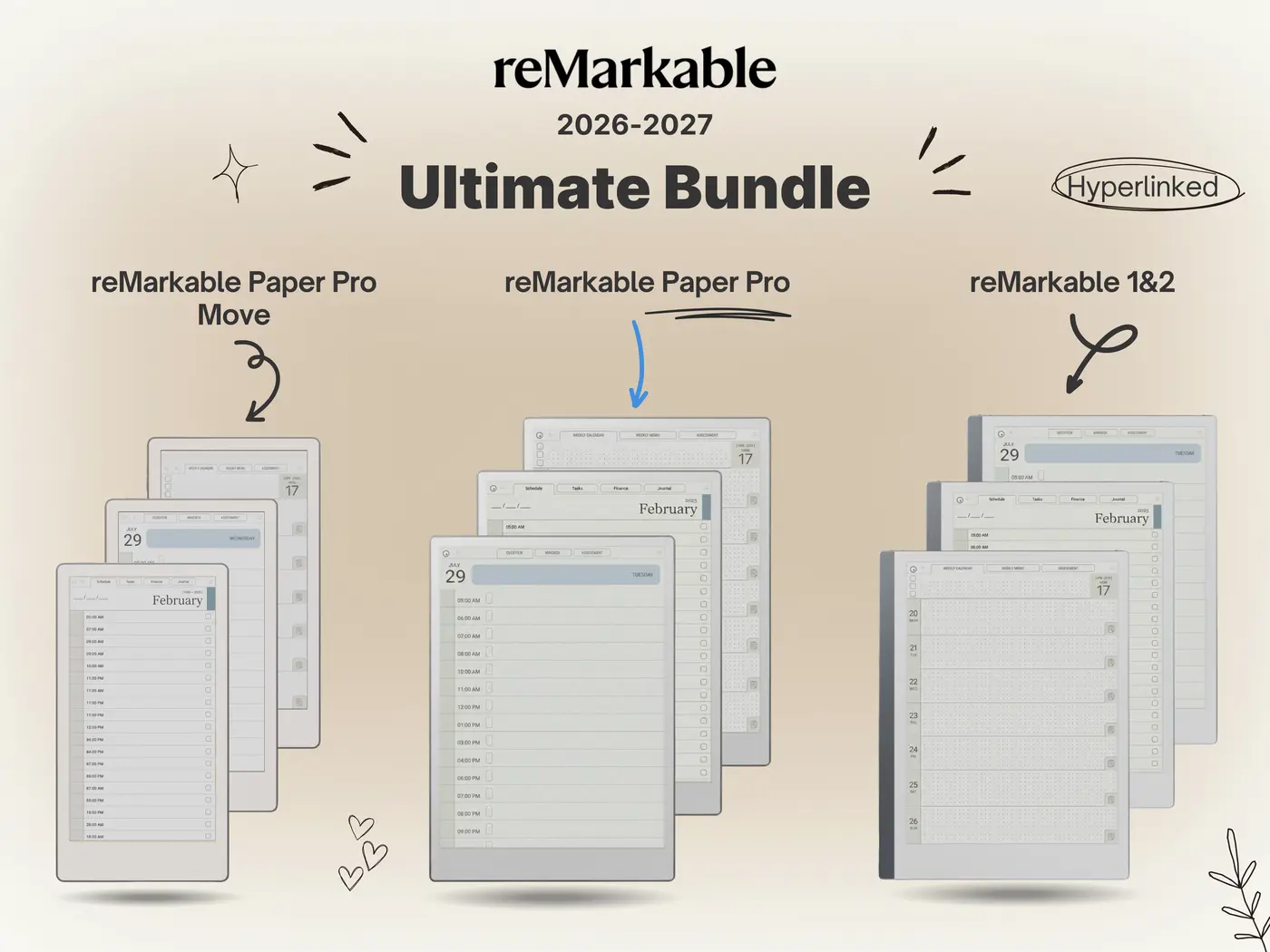
No matter which brand you migrate to, you need the right framework to stay organized. Unlock your new tablet’s full potential with our Ultimate 2026 Template Bundles, hyperlinked and perfectly scaled for any 10-inch or 11-inch display.
Shop the Professional Template Bundles