The state of play
What the Boox Go Color 7 Gen 2 actually changed
The Boox Go Color 7 Gen 2 is on sale now, listed on Boox’s own Go 7 Series page next to the first-generation model and the mono Go 7. This page used to be a prediction and it was wrong about nearly everything, so it is worth being blunt about what the spec table says instead. Gen 2 is $289.99, the mono Go 7 is $269.99, and the Gen 1 was $219.99 in white and $249.99 in black before it sold out.
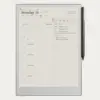
Line the two up and the Gen 2 changes exactly two things. It takes a pen, the BOOX InkSense or InkSense Plus, where the Gen 1 takes no stylus at all. And it runs Android 13 where the Gen 1 runs Android 12. That is the list. Same Kaleido 3 panel, same 300 PPI mono and 150 PPI colour, same octa-core CPU, same 4 GB of RAM and 64 GB of storage, same 2300 mAh battery, same 6.4 mm thickness, same 195 grams, same front light, same microSD slot, same Play Store. The panel refresh we predicted did not happen, and the storage and RAM bumps we predicted were never needed, because the Gen 1 already shipped 4 GB and 64 GB.
The Kaleido 3 panel was the obvious upgrade target, and Boox did not touch it. Kaleido 3 renders colour at 150 ppi over a 300 ppi monochrome layer, which produces sharp text and acceptable colour artwork with known costs: weak red saturation, a visible lag on full-page colour refresh, and ghosting that persists in A2 mode. A move to Gallery 3, the higher-end E Ink colour panel, would have addressed those. Boox’s spec table lists Kaleido 3 on both generations, so if the colour rendering is what you wanted improved, the Gen 2 is not the upgrade you were waiting for.
What to expect
Gen 2 against Gen 1, from Boox’s own spec table
The whole 7-inch Go line, side by side
The Gen 2 cost $70.00 more than the white Gen 1, and that bought pen support and one Android version. Every other row on Boox’s table is identical.
Specs and prices read off Boox’s Go 7 Series comparison table, 1 August 2026, taking the US warehouse in each case. The “with a pen” row is Boox’s own InkSense Plus bundle; buying the $45.99 stylus separately costs $12.99 more.
Read the stylus row twice, because it is the only one that changes what the device can do. The Gen 1 is a reader and nothing else; Boox lists no compatible pen for it. The Gen 2 accepts the InkSense and InkSense Plus, which Boox names by exact model in a footnote, so a generic Boox pen from an older device will not work either. If you want to annotate on a 7-inch colour screen, the Gen 2 is the only one of the two that will do it, and now that the Gen 1 has sold out it is the only one you can buy.
Which one to buy
Buy the Gen 2, because the Gen 1 has sold out
For a while this was the rare generational upgrade where both models stayed on sale, so the only question was whether you would ever put a pen on the screen. That window has closed. The Gen 1 is now sold out in white and black, from both the US and the Hong Kong warehouse, so the Gen 2 at $289.99 is the 7-inch colour Boox you can actually buy. If a pen is part of the plan, take Boox’s own InkSense Plus bundle at $322.99 rather than adding the $45.99 stylus to a bare device, because the bundle saves $12.99 for the same two items.
What it really is, is the Gen 1 with a pen digitiser, and now that the Gen 1 has gone that is the whole 7-inch colour Boox line.From the takeaway block
One caveat on the Android gap, since it is the other half of what the seventy dollars bought. Android 12 against 13 changes nothing about reading, and both models ship the Play Store, so Kindle, Kobo and Libby install the same way on either. It matters only at the far end of the device’s life, when apps start requiring a newer runtime than the Gen 1 can offer. That is a years-away concern, not a reason to spend now.
Buy or wait
How the Gen 2 sits against the rest of the Boox line
The comparison that matters now is sideways rather than backwards. At $289.99 the Gen 2 sits $20 above the mono Go 7 at $269.99, and that twenty dollars is the entire colour panel, which makes it the easiest upgrade in the range to justify if you read anything illustrated. Comics, manga, children’s books and technical PDFs with diagrams are where Kaleido 3 earns its keep. If your reading is plain novels, the mono Go 7 is the sharper screen and the cheaper one, and colour buys you nothing.
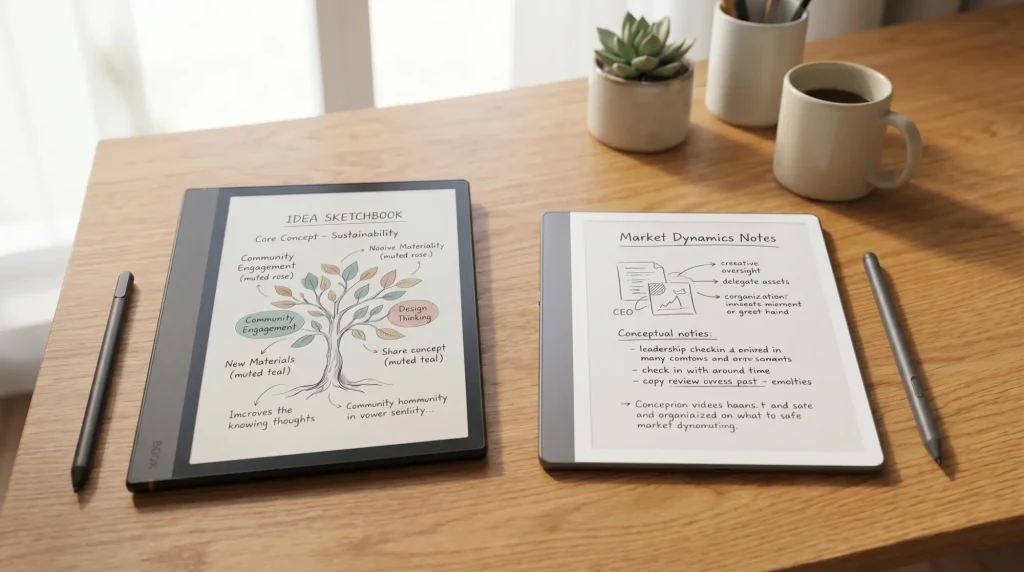
If note-taking is the primary use, be honest with yourself about the screen size before the generation. Seven inches is a notebook page you hold in one hand, not a document you mark up. The InkSense works and the digitiser is the reason the Gen 2 exists, but the constraint is the panel size, and no firmware fixes that. Writers who mostly annotate PDFs will be happier one size up.
If you are weighing the Gen 2 against the Boox Note Air 4 C (10.3-inch colour), the form factor is the bigger decision than the generation. The Note Air 4 C is the right device for desk-bound note-taking and 10-inch reading; the Go Color 7 is the right device for one-handed reading and travel. Pick the form factor first, then the generation.
FAQ
Common questions, answered briefly
When is the Boox Go Color 7 Gen 2 release date?
What is new in the Boox Go Color 7 Gen 2 compared to the Gen 1?
How much is the Boox Go Color 7 Gen 2?
Can you still buy the Boox Go Color 7 Gen 1?
Will Boox Go Color 7 Gen 2 work with Gen 1 templates and accessories?
Does the Boox Go Color 7 Gen 2 have a Gallery 3 panel?
If yours is not above, drop the question in the comments and we will answer it under the next Boox piece.
People also ask